.png?width=235&height=55&name=LV%20Logo-02%20(1).png)








.png?width=300&name=About%20(1).png)
.png?width=300&height=70&name=LV%20Logo-02%20(1).png)


The June quarter rental data is in, and the headline is continued growth at a slightly more sustainable pace. National rents rose 1.6% over the quarter, easing from the 2.1% recorded in March, yet annual growth accelerated to 5.9%.
To put the last few years into perspective, national rents have risen 40.6% over the past five years, adding $204 per week to the median rent. In the five years before that, the increase was just $55 per week. It is little wonder that around a third of the median household's income now goes to rent, up from 27% five years ago, and affordability is starting to act as a natural handbrake on how much further rents can run, particularly in regional areas.
The common thread across every capital is supply. Vacancy rates are below 2% in every capital city, and total rental listings are sitting 16.7% below the five-year average.
Brisbane keeps closing the gap on Sydney
Brisbane's median rent reached $734 per week in June after annual growth of 6.4%, making it the third most expensive capital behind Sydney ($841) and Perth ($784).
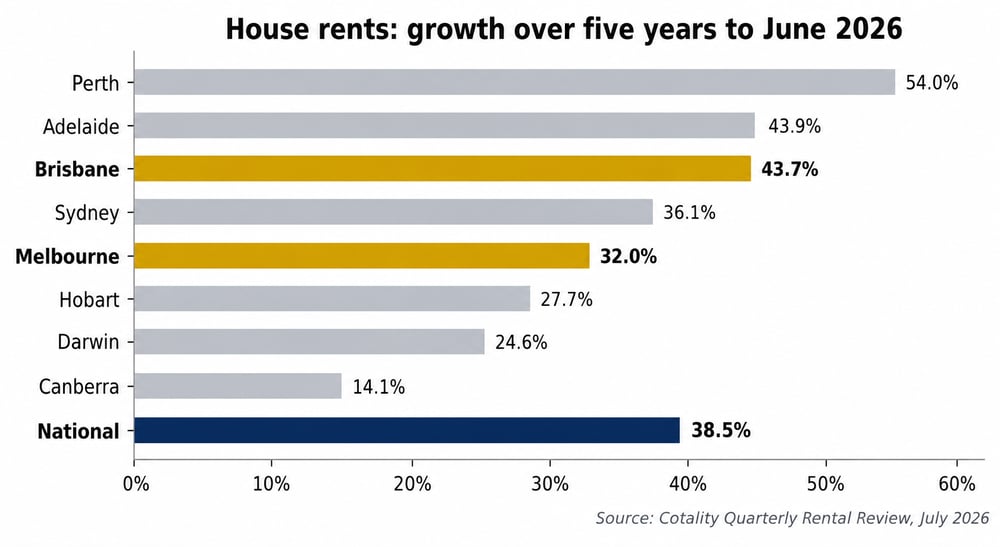
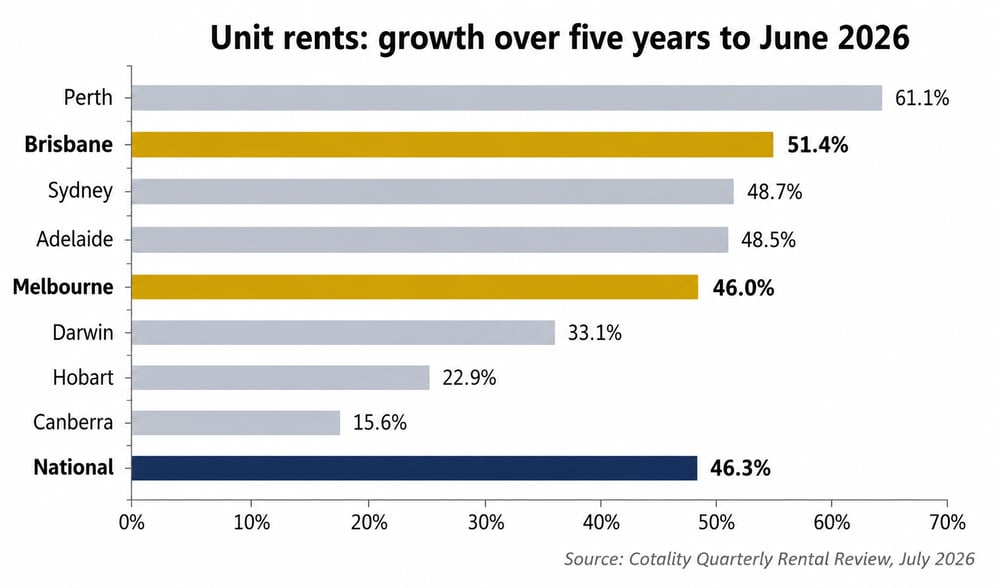
Readers with long memories will recall that before the pandemic, Brisbane's median rent sat below Melbourne's. Today it is $93 per week higher, and the gap to Sydney, which was once well over $150, has narrowed to $107. Vacancy at 1.9% is a touch higher than a year ago, and quarterly growth of 1.7% suggests the market is strong but no longer running at the frantic pace of 2023 and 2024. Over five years, Brisbane unit rents have risen 51.4% and houses 43.7%, among the strongest results in the country.
Melbourne remains the value capital, and it is tightening again
Melbourne's median rent of $641 per week is the lowest of the mainland capitals and a full $200 per week cheaper than Sydney. Annual growth of 4.9% looks modest next to Brisbane, but the conditions underneath point to a market with room to run.
Vacancy tightened from 1.5% to 1.3% over the year, the second lowest of any capital after Adelaide. Rental listings are 18.4% below the five-year average, the third tightest of any market in the country. And because Melbourne home values have softened while rents keep rising, gross yields have lifted from 3.6% to 3.9%, now the highest of the five largest capitals. We have said before that Melbourne rents cannot stay this far below the other major capitals indefinitely, and the June quarter did nothing to change our view.
What we are seeing across our own portfolio
Citywide medians hide as much as they reveal. Across the properties we manage in Melbourne and Brisbane, the growth is not evenly spread, and the dividing line is new supply.
In the inner and middle ring suburbs, where very little new rental stock is being added and demand is deepest, rents are growing well above the citywide figures, and quality properties are leasing quickly with strong competition. In the outer growth corridors, it is a different story. New estates and housing completions keep adding rental supply, and in those areas rental growth is modest and in some pockets, rents are falling.
This mirrors what we saw with prices during the last cycle: the headline number is an average of two quite different markets. Where your property sits on that map matters more than the citywide median.
What does all of this mean for property owners?
- If you have a vacant property in an inner or middle ring suburb, our advice remains to price at the top of the appraised range and let the level of enquiry tell you whether an adjustment is needed over the campaign.
- In outer growth areas, realistic pricing matters more, because renters have genuine alternatives in nearby new stock. In these areas there is a real premium on retaining a good existing renter rather than testing the market.
- For lease renewals, the right increase depends on the renter's history, your own circumstances, and how your suburb is actually moving rather than the citywide average.
As always, every property and every tenancy is different. If you would like to talk through what the market is doing in your suburb, reach out to your property manager.
Source: Cotality Quarterly Rental Review, July 2026.