.png?width=235&height=55&name=LV%20Logo-02%20(1).png)








.png?width=300&name=About%20(1).png)
.png?width=300&height=70&name=LV%20Logo-02%20(1).png)
 5 MIN READ | By Tim Beasley | Updated on Aug 7, 2026
Melbourne’s property market has most certainly turned. After a promising 2025, values have been drifting lower since late last year, and July’s data confirms this is no longer just a Sydney and Melbourne story, but a national one. As always, we’ll cut through the noise and look at what’s happening, what’s driving it, and what it means for property owners.
Melbourne at a glance: how far, how fast?
In July, Melbourne dwelling values fell 1.2% according to the Cotality Home Value Index, taking the decline over the past three months to 3.4%. Values are now 2.8% lower than a year ago. The current pace of declines in dwelling values is one of the steepest in living memory.
Melbourne isn’t alone. Nationally, values fell 0.7% in July, the largest single-month decline since December 2022, with Sydney down 1.4% and previously resilient markets like Brisbane and Adelaide now also recording falls.
One notable feature of this downturn is that it’s heavily weighted toward higher-value properties. Nationally, upper-quartile home values fell 3.2% over the three months to July while the most affordable quarter of the market actually rose 0.3%. In Melbourne, premium inner and middle-ring suburbs are leading the declines, while more affordable areas such as Sunbury and Brimbank are still recording modest annual growth.
What’s driving it?
Three things, in our view:
- Interest rates. The RBA has lifted the cash rate three times this year, reducing borrowing capacity and adding to repayment pressure.
- Tax changes. The May Budget’s changes to negative gearing and capital gains tax have clearly spooked investors. Many are sitting on the sidelines; some are selling. As we wrote in June, a tax headline is rarely a good reason to sell a sound asset.
- Confidence. Cost-of-living pressures, higher fuel costs and general economic uncertainty have made buyers cautious. Capital city auction clearance rates have sat below 50% since late May, although Melbourne’s recent weekends have held up better than most.
Where to from here? June quarter inflation came in softer than expected and most economists now expect the RBA to stay on hold for the rest of the year. But it is very difficult to predict the short-term performance of any market at any point, and we’d be wary of anyone who claims otherwise.
Sellers are quietly retreating
An important shift is underway on the supply of new sales listings. The flow of new listings coming to market has deteriorated in recent weeks as would-be vendors assess conditions and choose to wait. Put simply: sellers who don’t need to sell, aren’t. This is a common trend that occurs in weak sales markets.
Total advertised stock remains elevated, at around 5.7% above the five-year average across the capitals, but that’s largely because properties are taking longer to sell, not because more are being listed. If the pullback in new listings continues, history suggests it will limit how far values fall. Vendor retreat is typically how housing downturns find their floor.
The rental market is a different story
While prices soften, Melbourne’s rental market remains firmly in positive territory:
-
Rents rose 5.1% over the past year
-
Vacancy remains below 2%
-
Gross rental yields have risen to 4.0%
There’s a straightforward reason rents are holding up: rental supply is shrinking. Suburbtrends analysis published in May found more than 22,000 former rental properties were sold nationally in just three months following the Budget, around 5,500 of them in Melbourne. Every ex-rental sold to an owner-occupier is one less home available to renters. Less supply of rental properties with an increase in the number of renters means rents only have one direction to go: up.
So, is Melbourne now cheap?
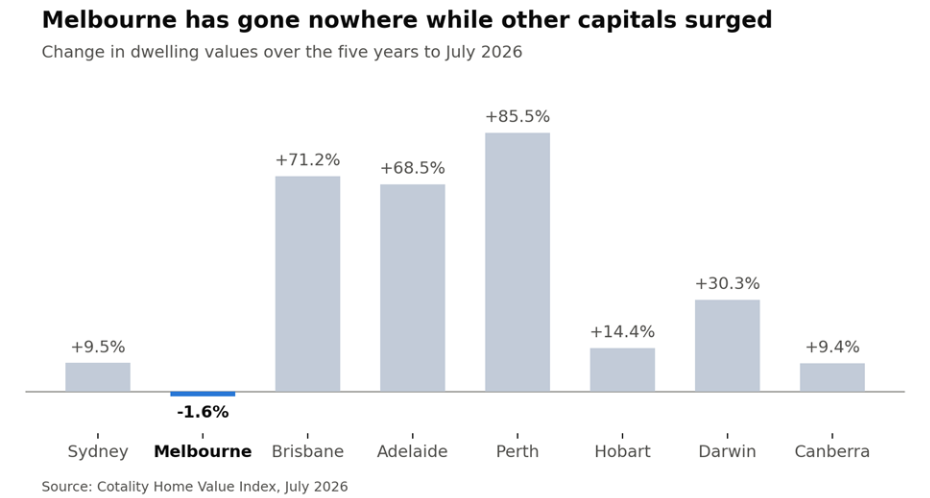
Regular readers will know our view. Over the past five years Brisbane property prices have risen more than 70%, while Melbourne’s have gone roughly nowhere. Melbourne’s median dwelling value now sits well below Sydney’s ($1.24m), remarkably well below Brisbane’s ($1.10m), and even below Adelaide’s. By historical standards, that gap remains about as stretched as it has ever been.
None of this tells you what prices will do next quarter or over the next year. But for long-term investors, a market with falling prices, rising rents, and far less competition looks rather different to the same market two years ago. Real estate is a long-term game, and short-term price declines don’t define long-term outcomes.
Two ways to play it (without buying another property)
A quick update on two things many of you have asked about. Last month we launched our second fund, the LongView Home Equity Fund, in partnership with Warakirri Asset Management, following the strong performance of Fund 1 (now closed to new investors). The Fund gives wholesale investors exposure to the capital growth of a diversified portfolio of quality family homes across the eastern capitals, without the stamp duty, the tenants or the management. In a soft market, owning a diversified slice of many homes rather than one more property is a strategy an increasing number of our clients are drawn to. If you’d like the Fund overview, just reach out.
And for existing owners: HomeFlex is now open to investment properties. HomeFlex lets you release equity today in exchange for a share of your property’s future growth, with no interest, no monthly repayments and no refinance. If you need capital but don’t want to sell into a soft market (or give up the grandfathered tax treatment on a property you already hold which, once sold, is gone for good), it’s well worth understanding. More than 200 clients have used HomeFlex over the past 18 months.
In a softer market, decisions matter more, not less. Whether you’re weighing up selling, holding, releasing equity or buying, we can help you look at the whole picture before you do anything. As always, feel free to reach out.